The New Brunswick government has begun the “data analysis phase” of its investigation into undiagnosed neurological symptoms affecting hundreds of people in seven provinces and whether environmental substances, such as heavy metals and pesticides, are a factor.
Dr. Yves Léger, the chief medical officer of health, made the announcement during a briefing in Fredericton Thursday.
His office has now received completed enhanced surveillance forms for 222 of nearly 400 patients from Dr. Alier Marrero, the Moncton neurologist who first sounded the alarm about a possible mystery disease several years ago, he said.
Staff believe this is “enough complete and verified patient data” to begin the next phase of the investigation, he said. “I’m therefore glad to say that that activity is now underway with the support of the Public Health Agency of Canada.”

Public Health officials say they will release findings by this summer after they finish analyzing data from more than 200 patients who have experienced symptoms of neurological illness.
The province created the enhanced surveillance forms for Marrero to fill out in early 2023 because the standard one-page notifiable diseases and events notification forms did not provide enough data, Léger said. Other jurisdictions have used such forms when they need to collect additional information on “an issue that’s of concern,” he said.
A public report with recommendations is expected this summer, and updates will be provided throughout the process with the help of a new website, Léger said.

It was early 2021 when the public learned that Public Health was monitoring more than 40 New Brunswick patients with symptoms similar to those of Creutzfeldt-Jakob disease, a rare and fatal brain disease. Symptoms range from painful muscle spasms and hallucinations to memory loss and behavioural changes.
The first case dated back to 2015, according to an internal memo.
An investigation under the former Higgs government concluded in February 2022 that the patients did not have a common illness.
An oversight committee that included six neurologists found “potential alternative diagnoses” for 41 of the 48 patients, including Alzheimer’s disease, Lewy body dementia, post-concussion syndrome and cancer.
Patient advocate worried
According to a letter Marrero wrote to federal and provincial officials last month, the number of patients suffering from unexplained neurological symptoms has jumped to 507 across New Brunswick, Nova Scotia, P.E.I., Newfoundland, Ontario, Quebec and Alberta.
Fifty people have died.
Patient advocate Stacie Quigley Cormier, whose stepdaughter Gabrielle Cormier, 23, is one of the youngest patients in the original cluster, worries the new investigation will end much like the first one — with few clear answers.

“It feels very similar to the last investigation where they reviewed files and then they wrote a report,” said Quigley Cormier, of Dalhousie Junction.
“I didn’t hear too much different,” she said, noting environmental concerns were raised as early as 2019.
Meanwhile, there was no mention of the investigation addressing the “disproportionate” number of patients like Gabrielle with autoimmune antibodies, she said.
Quigley Cormier hoped to learn more during a meeting Premier Susan Holt and Health Minister Dr. John Dornan were expected to hold with patients and their families late Thursday. She described the meeting as “five years in the making.”
Previous investigation ‘appropriate at the time’
Asked whether it was a mistake to conclude the previous investigation without looking into possible environmental causes, Léger said he believes it “was appropriate at the time.”
The objective of that investigation was different than this one — to determine if there was a common disease, he said.
“Had the specialists said that, ‘Yes, we believe that there is something in common within those patients,’ then that would have triggered more work, more research to find the common causes and the environmental aspects would have been part of that.”
The latest investigation started with a “scoping exercise” in May 2023 after Marrero provided “actual test results suggesting elevated levels on some environmental substances, more specifically heavy metals and pesticides,” including the herbicides glyphosate and glufosinate, Léger said.
Some patients and advocates have questioned why Public Health couldn’t have started this investigation sooner, based on the patient forms Marrero had previously submitted, but Léger said they “needed to make sure that the data is as complete and accurate as possible … so that the findings from the analysis can be relied upon.”
Feds to conduct scientific review
Once the data analysis phase is complete, likely by the end of April, the province will issue a news release and update the new website, said Léger.
The results will then be provided to the Public Health Agency of Canada for “interpretation and scientific review,” which is expected to be completed by the end of May, when another news release will be issued, he said.
Public Health will then combine this with its own interpretation and publish a report with recommended next steps.
Possible source not part of probe
It’s too soon to talk about identifying possible sources of exposure, Léger told reporters.
If elevated levels that pose a risk to health are confirmed, how and where they were exposed could be part of a further study.
But officials first need to look at the types of tests Marrero conducted and whether those align with best practices, he said. Certain heavy metals are best tested through blood, for example, and others through urine.
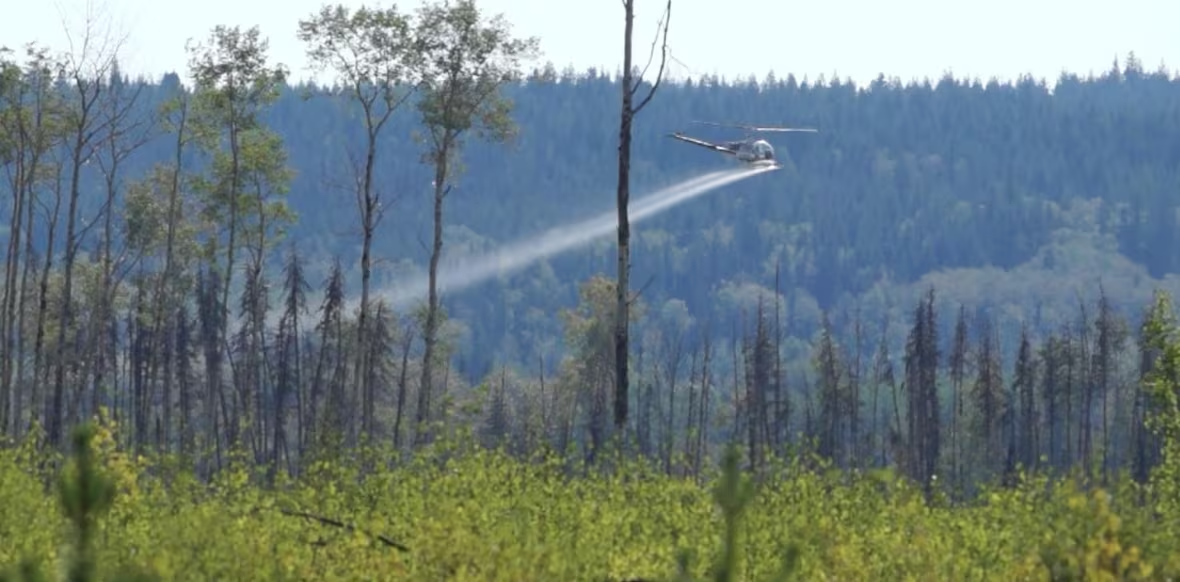
Province will respond ‘responsibly’ to any link to glyphosate
In December, the premier told CBC News her government would be willing to ban glyphosate if the investigation found a link to the “mystery illness.”

But in a separate news conference Thursday, Holt stopped short of committing to immediately legislating on glyphosate spraying if a direct link to the herbicide used in agriculture and in industrial forestry operations is established.
Her government will respond “responsibly” with the information provided, she said.
“We really need to look at patient data to understand the commonalities across hundreds of patients to inform the most appropriate external and environmental research,” Holt said in French.
N.B. remains lead on probe
Although patients and advocates like Quigley Cormier have repeatedly called for the Public Health Agency of Canada to take the lead, raising concerns about bias and lack of transparency, Léger said he firmly believes it continues to fall within the jurisdiction of the province to investigate.
“By and large, almost all the [392] patients that are have been reported to us are patients from New Brunswick or have a link to the province,” he said.
Only 16 are from outside the province, mostly the Atlantic provinces, and at least six of them have current or previous medicare numbers, Léger said.
In addition, “this continues to be reported by mainly one physician in New Brunswick,” he said, referring to Marrero.
Having said that, “There will likely be additional work that needs to be done,” Léger said, “and there may be a different role or a bigger role to play for Public Health Agency of Canada at that point.”

Holt told media last week that the agency had denied her request to take the lead on the investigation. But Léger said Thursday that as the person who has led the investigation for the past year, he was unaware of any such request.
Asked to clarify, Holt said there were “maybe some misunderstandings around language.”
“A leadership role or a partnership role, I think is getting into some of the semantics of it, but they’re being very helpful and we’re doing the work together,” she said.
“The bottom line is it needs to move faster, that we need all hands on deck.”
No representatives from the Public Health Agency of Canada participated in the news conference because the federal government is “in caretaker mode” now that the election has been called, Léger said. “They were certainly very eager to be here.”